

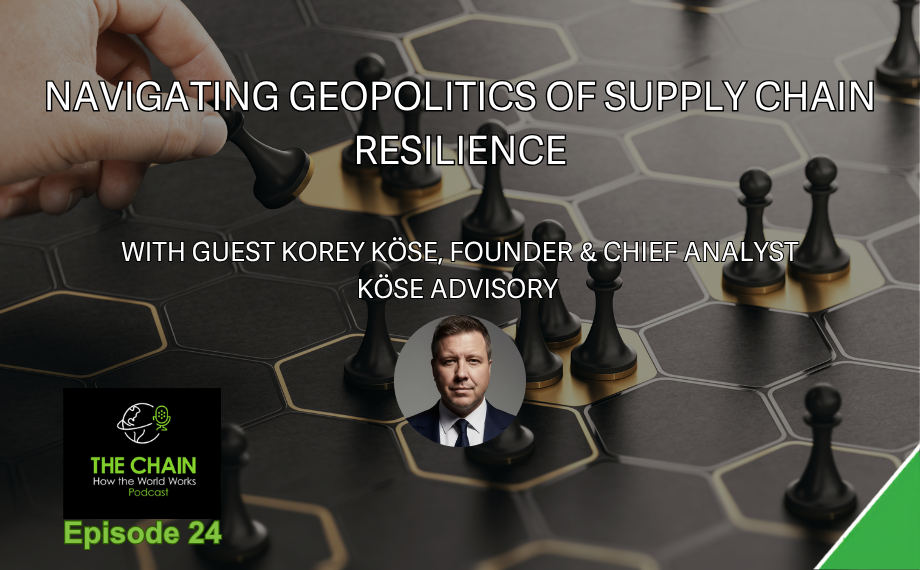
For decades, many business leaders considered the supply chain as a back-office function — a necessary and operational, but supportive, role that maintained production and oversaw the logistics of the business’s goods or services. When C-suite executives gathered to discuss enterprise goals and financial investments, the chief supply chain officers (CSCOs) often remained outside the room. In this episode of ASCM’s The Chain podcast, guest Koray Köse, founder and chief analyst of KÖSE Advisory, urges organizations to look to their CSCOs to navigate disruption, and global geopolitical shifts while building supply chain resilience. Supply chains are a critical driver of business strategy and competitive advantage; they must be prioritized as such.
Key takeaways
Supply resilience is no longer defensive — it’s strategic
Tariffs, sanctions, elections and export controls influence global supply chains, making disruption more common and complex. As a result, resilience can’t be treated as a reactive safeguard; it must be embedded directly into business strategy.
The CFO-versus-CSCO gap is holding companies back
Organizations often struggle to align short-term financial goals with long-term supply chain risk. Chief financial officers (CFOs) focus on quarterly cost performance, while supply chain leaders operate on longer timelines shaped by future disruptions. Organizations that treat resilience as an investment and not a cost center gain a competitive edge when disruptions hit.
AI won’t fix broken supply chains without readiness
Most organizations have adopted AI or are at least already on their AI journey. However, many businesses fall short on the AI adoption path and end up abandoning efforts. This is due to poor data quality, fragmented systems and outdated processes that limit ROI and create frustration. Before investing in new technology, companies must build a strong foundation across talent, data and processes to enable meaningful transformation.
Supply chains are a strategic infrastructure in geopolitical resilience
Globalization has created dependencies that can quickly become vulnerabilities when geopolitical tensions arise. A geopolitical supply chain expert, Köse contributes strategic intelligence assessments, geopolitical analysis and human intelligence context to senior government, national security and intelligence community forums across the globe. His research demonstrates how supply chains are now being used and weaponized through policy decisions. The ongoing trade wars and sanctions force leaders to rethink how they design and manager their supplier networks.
CSCOs need to know exactly who is in their supplier networks to gauge how geopolitical disruptions affect the extended tiers. This pushes supply chain leaders out from the execution level of operations and makes them strategic decision-makers. The time of supply chains simply being optimized for cost, speed and efficiency is over. Today’s geopolitical environment calls for a network that shapes how businesses compete and grow in unstable times.
Supply chain visibility, risk and the new threat landscape
Supply chain risks are evolving. Cybercriminals know it’s best to target lower-tier suppliers due to their lack of defenses. Visibility into all supplier levels is necessary to keep cyberattacks, ransomware and data leaks at bay. This is the moment supply chain talent, technology and strategy merge. Leaders need to think beyond physical goods and consider digital exposure, including software dependencies and data flows. They must see supply chain visibility as a critical component of resilience and risk management.
This investment goes beyond the tech. Trained supply chain teams can transform defensive software into offensive operations. Industry professionals with the technology know-how can forecast threats and prepare organizations for what’s to come, instead of waiting for something to happen.
Building a supply chain for the next decade of geopolitical resilience
Organizations that win won’t just react to disruption — they’ll design for it. That means building supply chains that are flexible, data-driven and aligned with long-term geopolitical and technological trends.
As Köse puts it, supply chain leaders need to become “expert generalists” who understand policy, technology and global markets. Proactive engagement with policymakers, smarter use of data and strategic product design will define success in the years ahead. Ultimately, the next generation of supply chain leaders will turn risk into opportunity.
An educated supply chain team is your best defense. Get them trained to stand on the front lines of operations. Explore ASCM’s training solutions.
Explore ASCM's training solutions
Navigating geopolitics of supply chain resilience FAQs
How do geopolitics affect supply chains?
Geopolitics influence trade routes and global partnerships through sanctions, blockades and tariffs. These elements can create tension in supplier relationships, delay shipments and raise the cost of goods.
What is a geopolitical disruption for supply chains?
Some examples of geopolitical disruptions for supply chains include tariffs, sanctions and blockades.
How will building supply chain resilience help organizations against geopolitical risks?
Supply chain resilience ensures operational continuity. Supply chains can take an active role when it comes to cost fluctuation and supply and demand through better demand planning and forecasting.
