
As a supply chain leader, you are under increasing pressure to improve performance, reduce costs, build resilience and respond faster to disruption. However, when you’re spending your day firefighting instead of proactively problem-solving, it’s difficult to identify gaps and opportunities for improvement. You need a common framework that aligns strategy, operations and measurable business results.
ASCM offers supply chain solutions that enable true transformation. The solutions are built around a common framework: the Supply Chain Operations Reference Digital Standard (SCOR DS). Using SCOR as our foundation, ASCM offers a suite of solutions to assess capabilities, benchmark performance and prioritize transformation initiatives. These solutions include SCOR-based assessments and SCORmark. Read on to discover how these tools can help you improve your supply chain operations.
What is SCOR?
ASCM’s SCOR DS is the supply chain industry’s only comprehensive, end-to-end framework that helps organizations measure performance, improve operations and connect strategy to execution. SCOR DS is a globally accepted, industry-agnostic, open-access supply chain authoritative model, used by organizations of all types, sizes and complexities. SCOR DS establishes a common language and definitions for processes, metrics, practices and skills to create a shared, objective foundation and help teams make informed decisions.
ASCM SCOR DS is:
- Comprehensive: SCOR spans all customer interactions from order entry through the paid invoice and all physical material transactions from sourcing to final delivery and return. It also covers market interactions, including understanding aggregate demand and order fulfillment.
- Globally accepted: More than 5,000 organizations around the world have used SCOR to build and improve their supply chains.
- Open access: Anyone with a free ascm.org account can access the complete SCOR DS framework for free online.
SCOR has been guiding supply chains for 30 years now. The supply chain solution is regularly updated to keep pace with the latest supply chain advancements and challenges. SCOR DS is the latest iteration of SCOR and incorporates digital technologies.
SCOR DS sets the stage for other ASCM supply chain solutions by creating a standardized framework. The framework creates a performance benchmark (SCORmark) and Enterprise Assessments that help uncover gaps.
What supply chain solutions does SCOR provide?
The SCOR framework enables organizations to make rapid improvements to their supply chain processes. SCOR aligns teams around a common set of processes, metrics and best practices. This helps improve reliability, responsiveness, agility, cost performance and asset efficiency — the outcomes that drive supply chain competitiveness.
SCOR DS in action
Keysight Technologies, a design, emulation and testing solutions provider, leveraged the SCOR DS to guide its supply chain transformation. Here’s a quick breakdown of the case study:
Challenge: Keysight Technologies wanted to make its supply chain more resilient without spending money on duplicate backup equipment. Instead of buying extra machines, the company used existing demo units as emergency backup equipment. The challenge was that they lacked visibility into where those units were located and how quickly they could be moved when needed, making it difficult to respond efficiently to disruptions.
Solution: The SCOR best practices helped the company successfully digitize operations. Keysight built a centralized digital platform that connected sourcing, logistics, and fulfillment and incorporated real-time insights tied to SCOR metrics. They also implemented dashboards, business intelligence tools, digital workflows and cross-functional collaboration processes to improve decision-making and responsiveness.
Results: The improvement and monitoring initiative helped the company significantly improve its key performance indicators, including an 80% reduction in order fulfillment time and a 10% decrease in annual capital expenditures, and achieve 100% on-time delivery performance.
Why should you choose SCOR instead of point solutions?
Point solutions, or specialized software applications targeted to one use case, are built to address a specific challenge, often without accounting for other interrelated challenges. When cross-functional challenges arise, the different point solutions are working from different baselines and definitions, so connection is disjointed. These situations create silos where supply chain growth and transformation get stuck.
What does the SCOR double-infinity diagram mean?
The SCOR double-infinity loop represents the continuous and connected nature of today’s supply chains. It shows that supply chain processes are not one-and-done activities, but that they may be revisited throughout the overall process and even shared among the supply and demand sides of the supply chain.
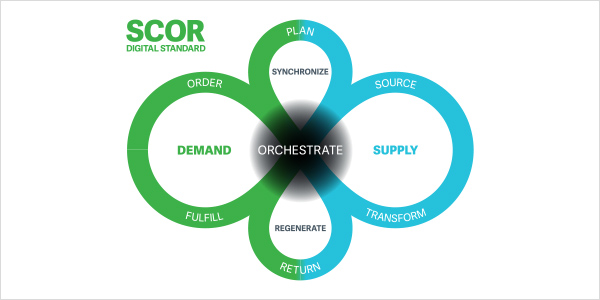
Orchestrate is at the center of the loops and touches all the other processes. It represents the processes that enable the supply chain to work effectively, including subprocesses like strategy, business rules, human resources and information technology.
The diagram has four other main areas:
- Supply: Includes the Source and Transform processes that acquire materials and convert them to the finished product or service.
- Demand: Includes the Order and Fulfill processes for receiving and completing customer orders.
- Synchronize: Includes the Plan process. Planning is required for the supply and demand sides of supply chain, so it is represented with two colors. Planning for all of the other processes must be synchronized to achieve supply chain efficiency.
- Regenerate: Includes the Return process. Like Plan, Return supports both the supply and demand sides, so it is represented with two colors. Return also is a critical factor for sustainability.
What does SCOR define?
SCOR sets the standards for supply chain operations by providing a common language for terms and processes. This keeps all stakeholders on the same page when planning and assessing supply chain improvement initiatives.
The process definitions assist supply chain teams with documenting their current environment and developing the future, improved state. This helps with quantifying gaps in service, cost and inventory.
The metrics definitions in the Performance section are particularly valuable because they can be used to measure and assess supply chain processes and determine where problems reside and what gaps need to be closed before making any supply chain improvements.
The practices definitions in the Best Practices section describe a unique way to configure a process, whether that involves applying automation, other technology, special skills, a specific sequence or a specific method. In total, the practice definitions help teams standardize and improve processes as well as identify practices that are impeding performance and need to be changed.
The skills definitions in the People section create a standard for describing the expertise required to complete certain tasks. This helps with managing the talent needed to support supply chain operations.
How does SCOR help standardize improvement?
SCOR captures a consensus view of supply chain management. It links business processes, best practices, technology and sustainability into a unified structure to support supply chain improvement activities. This in turn improves team communication and overall supply chain effectiveness. For improvement initiatives, SCOR guides supply chains in documenting their current state to set a baseline for improvement.
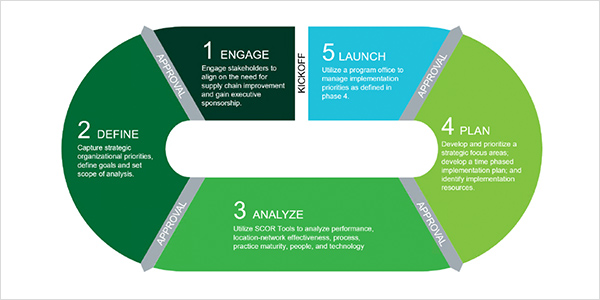
The SCOR Improvement Program Racetrack guides supply chain teams through the improvement process. The racetrack is a metaphor, showing that supply chain improvement is never truly complete. As one SCOR project is completed, the improvement team should start identifying new ones. Typically, an organization can complete three SCOR projects in a year.
How can I use SCOR to map operations before making a major change?
The SCOR definitions provide the tools for mapping supply chain operations. After documenting your current state, you can use the metrics definitions to detail the changes you’re hoping to achieve. Then you can start mapping your operations to SCOR processes by category to identify any gaps or misalignments. You might discover you’re applying a make-to-stock forecasting process for a make-to-order product line, for example. Then, you can rearrange the elements of your as-is map to match your goal state. This creates a clear guide to improvement.
What are ASCM Assessments?
ASCM offers four free SCOR-based assessment tools to help supply chain leaders gain actionable insights about supply chain maturity and competitiveness. Each assessment uses the SCOR framework as its foundation, providing a structured way to evaluate capabilities, identify gaps and prioritize improvement opportunities. The assessments offer clear visibility into current capabilities and weak spots, custom reports with actionable recommendations, data to support investment in supply chain transformation and guidance about supply chain development strategies.
The assessments answer your burning questions. If you’re wondering:
How capable and integrated are we today?
Check out: The ASCM Supply Chain Maturity Assessment
The ASCM Supply Chain Maturity Assessment provides a high-level view of supply chain maturity across the seven SCOR process areas. This offers an excellent starting point for an organization’s supply chain transformation journey. It also helps identify key capability deficiencies and potential next steps to address those areas.
Do our people and roles support execution?
Check out: The ASCM Organizational Skills Assessment
The ASCM Organizational Skills Assessment provides a clear, data-driven view of workforce capabilities and opportunities for improvement. This helps leaders make better hiring, training and development decisions that strengthen teams and prepare them for the future.
Are our operations efficient, ethical and sustainable?
Check out: The ASCM Supply Chain Sustainability Assessment
The ASCM Supply Chain Sustainability Assessment evaluates supply chain performance across economic, environmental and ethical dimensions for a balanced, triple-bottom-line approach. It measures maturity across 30 focus areas derived from the ASCM Enterprise Standards for Sustainability and SCOR DS.
Are we ready for digital transformation?
Check out: The Digital Readiness Assessment
The Digital Readiness Assessment considers a supply chain’s digital maturity across supply chain processes and identifies gaps across the four main SCOR areas by leveraging the SCOR Digital Capabilities Model. The results help leaders prioritize smarter investments to accelerate transformation; align teams around a shared digital vision; and build a resilient, future-ready supply chain.
Choose one, some or all of the assessments to gain a clear picture of your current state and your transformation journey ahead.
For each of these assessments, just complete the online assessment form, and then ASCM’s expert team will analyze your answers and create a facilitated view of your results, including your supply chain maturity level and improvements among the four key SCOR areas: performance, processes, practices and people.
What is SCORmark benchmarking?
SCORmark benchmarking helps supply chain leaders understand where they stand today, identify their biggest performance gaps and prioritize the improvement initiatives most likely to deliver measurable business impact. The benchmark leverages the standardized SCOR DS framework plus PwC’s data about more than 1,500 organizations and 2,500 supply chains to benchmark a supply chain’s operations against industry peers. The metrics-based assessment helps supply chain leaders identify and close gaps to elevate their supply chain performance and achieve supply chain transformation — or a supply chain redesign that builds resilience, efficiency and effectiveness — that delivers a true competitive advantage.
SCORmark benchmarking delivers a detailed report measuring performance for SCOR’s five Performance attributes: Reliability, Responsiveness, Agility, Cost and Asset Management Efficiency. It then drills down into specific metrics to identify where the supply chain is on par with other supply chains, where it outperforms peers and has a strategic advantage, and where it needs to focus its improvement efforts to transform the supply chain.
Quantifying the gaps between current performance and targets or peer performance enables supply chains to set their transformation priorities with confidence. The data breakdown shows how much metrics need to improve to surpass industry peers, justifying the investment in transformation initiatives. SCORmark benchmarking is free to Talent Development and Enterprise Transformation ASCM corporate members.
What's your next step in your supply chain transformation journey?
With so many SCOR resources available through ASCM, it can be difficult to know where to start. To decide, take a look at your needs now. If you need:
A standard and common language.
Start with SCOR DS.
A diagnostic to decide where to focus your efforts.
Start with ASCM assessments.
Quantitative benchmarking.
Start with SCORmark benchmarking.
How the SCOR supply chain solutions fit together?
ASCM’s practical supply chain solutions help organizations understand what excellence looks like, where they stand today in relation to that excellence and how to prioritize improvement investments.
Together, the SCOR supply chain solutions guide you on your journey to supply chain transformation:
- SCOR DS sets the common, objective framework for process definitions, metrics definitions, skills and best practices.
- SCOR assessments diagnose the reality.
- SCORmark benchmarking quantifies performance gaps against peers and prioritizes the next steps to take action.
The SCOR supply chain solutions create a smarter roadmap for supply chain transformation. Organizations can then prioritize investments, align teams and execute improvement initiatives with greater confidence.
ASCM offers a variety of resources to help you use SCOR to its fullest potential, including a free introductory online course, the SCOR Quick Reference Guide, a two-day instructor-led SCOR class and case studies about success with SCOR.