
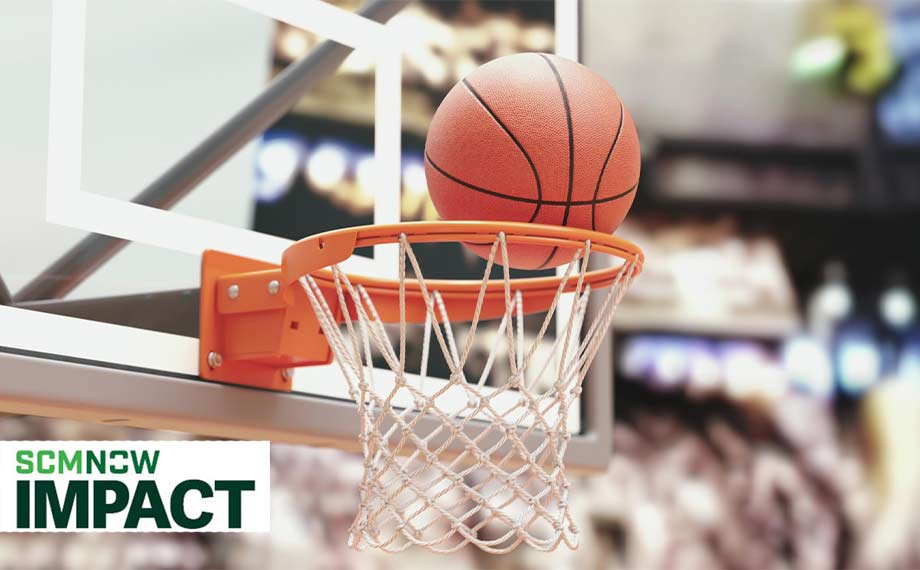
As March winds down, millions of basketball fans are locked into the raw energy and bracket-busting drama of March Madness. This annual tournament is more than just a series of games; it’s a shared cultural moment that connects us through the pursuit of a national championship. The NCAA Division I tournament started less than 100 years ago, but the sport was actually invented during a 19th-century Massachusetts snowstorm. To keep students active indoors, the first basketball game involved only two peach baskets, a ball and a “complete brawl” on the gym floor.
Unsurprisingly, the infrastructure required to pull off today's national spectacle has evolved into a masterpiece of global synchronization. Take Spalding, which manufactures basketballs with an astonishingly far-flung supply chain: Cowhide is sourced from North America; pressed on machines fitted with German-made embossing plates; shipped to China for manufacturing; and assembled with nylon winding made in Japan and rubber from Malaysia or Vietnam, explains ESPN. Finished balls are then shipped via ocean freight to Alexander City, Alabama, where they’re tested in a process that can take four weeks. “Balls are checked for diameter, weight and rebound — so they're dropped from six feet and expected to bounce 52-56 inches high.”
For Wilson, the official basketball manufacturer of the NCAA, the process is similar and even starts with the same Chicago-based leather supplier, Horween Leather Co., per The Los Angeles Times. “Turning a blue-tinted steer hide into a pebbled sheet of leather ready for shipment to a Chinese factory, where Wilson’s basketballs are manufactured, takes about 22 working days,” including tanning, drying, dyeing and embossing.
But the equipment isn’t the only aspect of the sport that requires an intricate supply chain. “College hoops’ postseason introduces a flurry of last-minute transportation, accommodation and security challenges to more than a dozen cities, requiring aid from countless logistics professionals and extreme flexibility from everyone involved to pull off its “unique brand of controlled chaos.” The NCAA also relies on third-party venders and operating teams to manage moving hundreds of athletes from game to game. Plus, custom merchandise needs to be produced and stocked in time for the big event. “The tournament is a case study in the importance of reliable expedite and just-in-time shipping .”
Supply chain professionals for the assist
If our global supply chain had a March Madness position, it would definitely be the elite point guard. You might not always see the work happening behind the scenes, but you certainly notice when the ball isn't moving. It’s the art of the no-look pass — executing complex maneuvers so seamlessly that the rest of the world only sees the score.
This is the spirit that drove ASCM to create our docuseries “The Chain: How the World Works,” streaming on Prime Video. Over six episodes, we shed light on how global supply chains shape the products and systems consumers use every day. For instance, the Sports episode explores the complex logistics required on and off the field, track and court to bring fans closer to the big game. Check out the full series today to discover fascinating innovations and meet the dedicated professionals keeping the ball in play.