
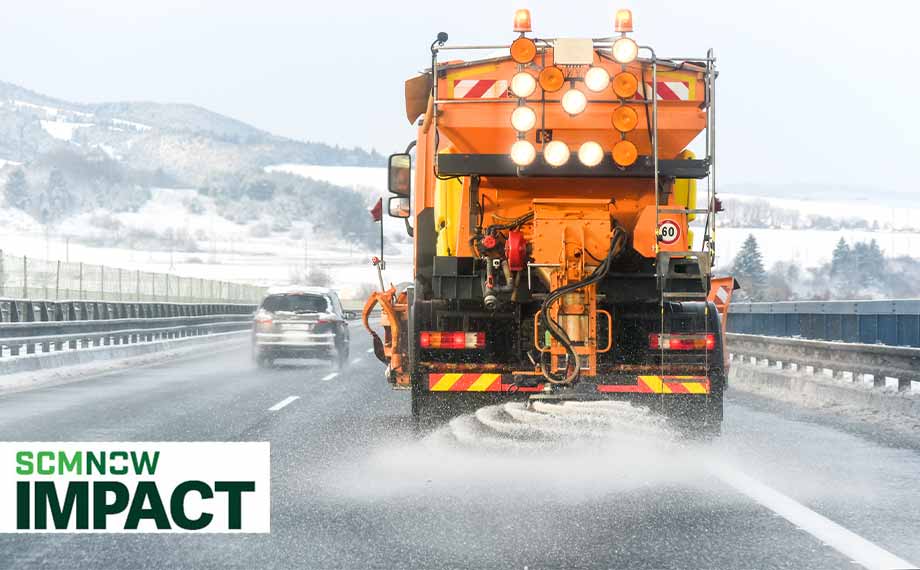
If you’ve spent the past couple of weeks digging out walkways and parking spots, you’re not alone. With 200 million Americans facing a relentless cycle of ice and snow, the consistent deep freeze has prevented even a hint of a melt. Meanwhile, our greatest defense — rock salt — often travels thousands of miles to get to our roadways, and under the current white-out volatility, even those massive supply chains are struggling to keep up.
In a typical year, New York City imports 900,000 metric tons of salt via the Port of New York and New Jersey. Recent weather has burned through a staggering 369,000 metric tons, underscoring the storms’ sheer intensity. The rock salt used to treat and prevent buildup of ice on New York’s municipal roads comes from Chile, Egypt, Mexico and Peru. Once a ship arrives, mounted cranes drop the salt into a funnel-shaped hopper on the wharf, reports the Port Authority of NY and NJ. Then, “a continuous stream of trucks” moves the salt from the hopper to a giant pile. For the three big salt providers — Morton Salt, Atlantic Salt and Prieto Enterprises — “there’s space to store about half a million tons on site.” From there, 3,000 truckloads per day set out for their final destinations.
Unfortunately, this intricate choreography is now being pushed to its breaking point. When the massive portside stockpiles can’t be replenished as fast as the trucks depart, the strain ripples outward from major hubs to local municipalities struggling to secure their share. With one major storm potentially triggering hundreds of orders, demand can cause a nationwide salt shortage, where sustained low temperatures require road salting for even very low-snowfall events.
Although major metropolitan areas have figured out ways to manage with the amount of salt on hand, numerous smaller towns have been shorted as much as half their salt orders. In much of Connecticut, labor and equipment delays are resulting in serious salt delivery backlogs. Cleveland officials, acknowledging their own shortage, have announced a “plow-more, salt-less plan” that prioritizes main roads, hills, dangerous intersections, and areas near hospitals and schools over residential streets. And in Lansing, Michigan, some de-icing companies have even received emails from their salt suppliers that simply state, “Everybody’s cut off. No more salt.”
Ready for all eventualities
Prepare to lead your organization through the next season of disruption by earning the ASCM Certified in Planning and Inventory Management designation. It’s a proven way to plan with precision, lead a digital transformation and execute the right strategies for your unique supply chain.
Meanwhile, trade the shovels for networking and the salt shortages for strategic breakthroughs at the premier gathering for supply chain leaders. Register now for CHAINge: North America, and look forward to California sunshine and great conversation all year long. After all, if you’re missing the warmth, Long Beach is the place for you!