Once a niche pastime in the frozen lochs of Scotland, curling has slid its way into the winter sports spotlight. This “chess on ice” is trading its quiet roots for high-stakes drama, captivating audiences with a unique blend of furious sweeping and tactical precision. It is, quite simply, the most oddly satisfying watch on the Olympic roster.
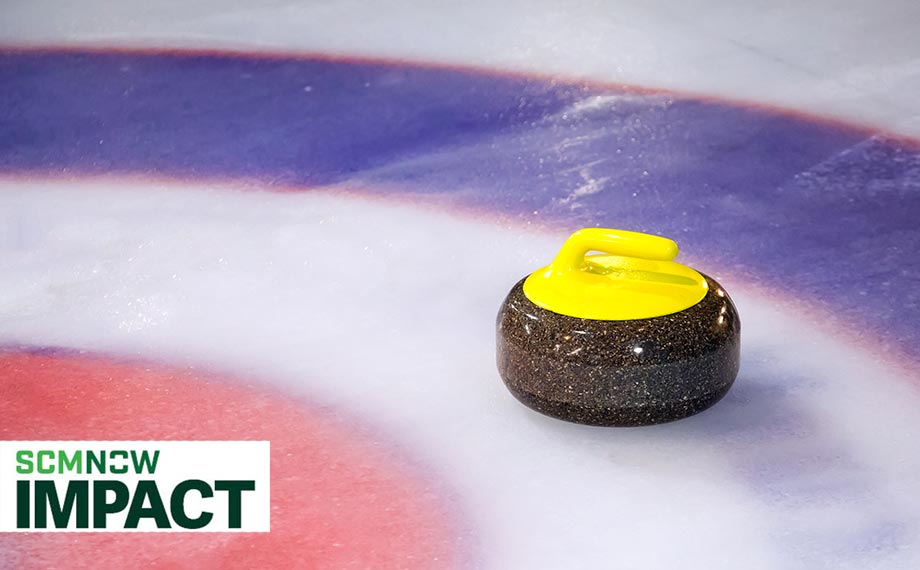
Curlers slide 42-pound granite stones across the ice while teammates vigorously sweep the path ahead to decrease friction and guide the stone's curl. Each 16-stone set weighs 700 pounds and requires custom-built crates for transit — a critical packaging investment given that the stones are valued at $15,000 each.
The challenge of moving the stones is eclipsed only by the geographical constraints of their origin. The microgranite is quarried from the cliffs of Ailsa Craig, an uninhabited Scottish island. Specialized landing crafts and beach ramps are needed to move the five-ton boulders. In addition, to avoid bird-breeding season, harvesting can only happen in November.
After extraction, the granite is shaped and polished at a mainland factory, where it undergoes a rigorous quality-control process overseen by a master technician who has personally vetted every Olympic curling stone for the past two decades. (This intricate journey from raw island granite to precision sports equipment is just one example of the complex logistics explored in the Sports episode of ASCM’s docuseries, The Chain.)
Once the stones are honed and shaped, they’re ready for the Games. This year, the action is taking place at Cortina Curling Olympic Stadium. Of course, reliance on indoor, climate-controlled environments is a modern necessity; historical records from the 16th century describe a game born from winters so harsh that natural lochs froze solid enough for the 700-pound stone sets. Compared to its first 1956 Games, Cortina now has nearly 20% fewer freezing days; thus the need for high-energy, refrigerated facilities. The current stadium was retrofitted to incorporate sustainable materials while enhancing energy efficiency. This involved greening the ice-production process, improving roof insulation and adding a new dehumidification system.
But the curling facility isn’t the only testament to the Olympic committee’s sustainability goals. Milano Cortina 2026 constructed very few new buildings, instead relying on updating existing sports venues and hotels across the Italian Alps to house the events and athletes. In fact, the only new Olympic Village was constructed using PEFC-certified timber sourced from Italian forests that were devastated by Storm Vaia and subsequent bark beetle infestations. This circular supply chain turned millions of cubic meters of damaged conifers into high-performance panels, enabling the project to meet a net-zero carbon target. To further advance sustainability goals, the roof is built from photovoltaic panels to generate peak electricity outputs, and new landscaping will improve cooling during the city’s very hot summers. In fact, the Village’s second life is already planned: It will be turned into affordable housing.
Sustainable solutions for the gold
Take a page from this year's Olympic playbook and lead your organization toward a smaller environmental footprint. By enrolling your team in ASCM's Building a Sustainable Supply Chain course, you’ll gain essential tools for managing the triple bottom line of people, profit, and the planet. Then, scale that impact with the ASCM Enterprise Standards for Sustainability. This SCOR-based framework delivers the world’s first comprehensive supply chain evaluation, ensuring your organization doesn't just compete, but leads the race toward a greener future.