
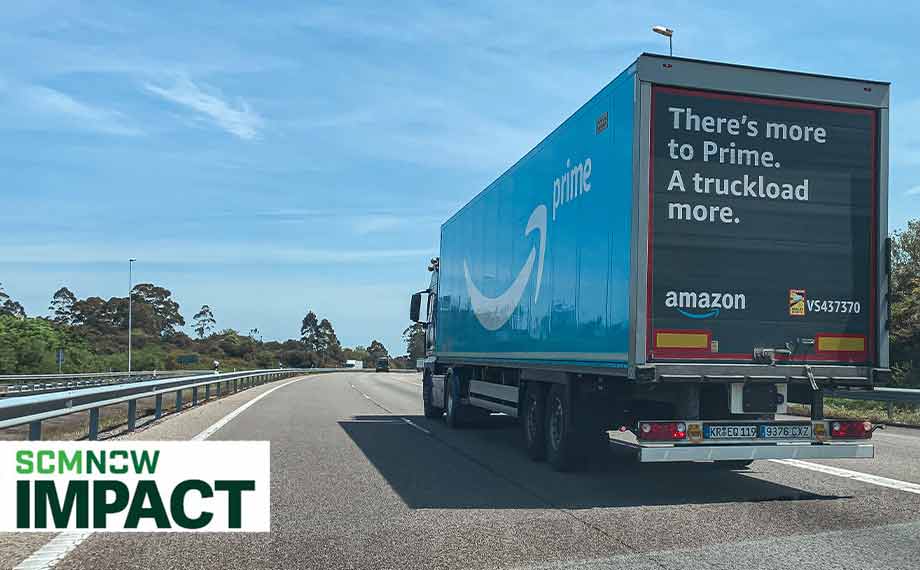
What began as a “garage-business” online bookstore has today evolved into a global infrastructure powerhouse, capable of moving goods at a scale that rivals the world’s busiest shipping hubs. In a ground-breaking transformation from retail partner to full-scale logistics competitor, Amazon is now offering to run your entire supply chain.
According to The Wall Street Journal, 3M, American Eagle, Lands’ End and Procter & Gamble are among the industry giants already piloting Amazon’s new supply chain services. For these early adopters, the partnership represents a strategic move to offload the capital-intensive heavy lifting of global fulfillment, enabling them to tap into Amazon's established scale.
This multi-modal infrastructure spans ocean, road, rail and air, featuring a fleet of more than 80,000 trailers, 24,000 intermodal containers and 100 aircraft. And by leveraging Amazon's unified inventory pools and advanced forecasting, users can achieve delivery speeds of two-to-five days. Just as Amazon Prime’s two-day promise normalized rapid fulfillment, outsourcing logistics to this established network allows other firms to meet heightened consumer expectations more efficiently.
The launch of the business also triggers a high-stakes level of competition with existing providers. With a fleet of more than 100 cargo planes — behind only FedEx and UPS — Amazon’s last-mile delivery service has become the nation’s largest parcel carrier by volume, using proprietary logistics technology to forecast demand, plan inventory and route freight. Third-party seller services accounted for 24% of Amazon’s total revenue in 2025, with $172 billion in net sales. However, until now, that business was mostly piecemeal, letting companies use Amazon for order fulfillment or shipping freight, but not as a consolidated, end-to-end supply chain solution.
Notably, Amazon is entering the broader third-party logistics market amid ongoing volatility, capacity constraints and rising transportation costs, per Supply Chain Management Review. FedEx and UPS have been shifting their focus away from retail shipments in favor of higher-profit health care, data center and business-to-business shipments, further differentiating the traditional carriers. And yet, “transportation logistics remains a vast and highly fragmented market,” argues Transport Topics. For instance, some industry experts believe that Amazon is selling access to its existing supply chain, while standard providers offer services that are more operationally complex and relationship-driven, as well as greater control over client data. Still, “Amazon’s forecasting models operate at massive scale, enabling inventory placement and demand planning capabilities that many enterprises struggle to replicate,” Supply Chain Management Review states.
Meet the moment with continued professional growth
As a supply chain professional, you’re more acquainted with the minutiae of logistics and transportation than most. But in today’s rapidly advancing industry, it pays to stay current on the latest in processes and practices. The Certified in Logistics, Transportation and Distribution program will help you increase efficiency in distribution and warehousing while mastering global logistics trends and the integration of automated fulfillment technologies. Sign up today to turn industry disruption into your competitive advantage.