
Contact ASCM at1-800-444-2742
Contact ASCM at1-800-444-2742
.
3D printing has revolutionized the way businesses design and produce products.
Understanding the significant impact of 3D printing, or additive manufacturing, is vital for supply chain professionals to effectively navigate the transformative opportunities it presents within the supply chain.
By earning your Supply Chain Technology Certificate, you'll gain the skills and knowledge required to drive innovation and efficiency and strengthen your career potential as a result.
Additive manufacturing is the process of creating three-dimensional objects by building up layers of plastic or metal materials in succession. 3D printing in supply chain offers numerous advantages, including reduced material waste, faster production times and the ability to create complex designs that are difficult to achieve with traditional manufacturing methods.
As businesses increasingly adopt additive manufacturing to stay competitive, professionals with expertise in this rapidly expanding technology are in high demand. Comprehending the importance of 3D printing is paramount for supply chain professionals.
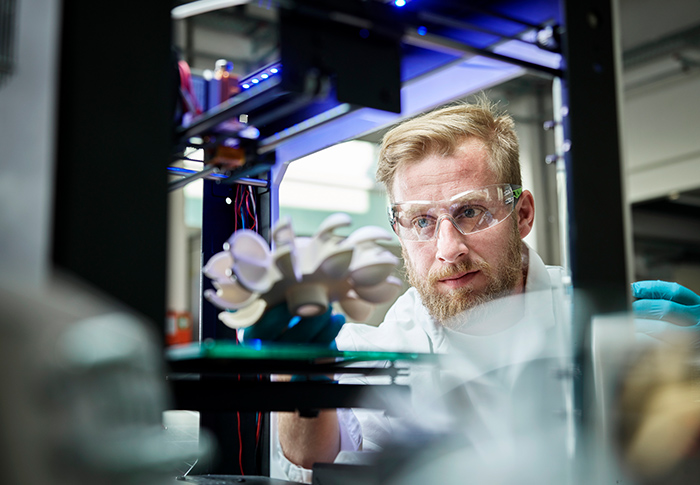
3D printing enables rapid prototyping and continuous product design improvement for supply chain professionals, reducing time and costs associated with traditional methods.
3D printing in supply chain reduces lead times by enabling on-demand production, allowing supply chain professionals to respond to demand fluctuations swiftly, optimize production schedules and minimize inventory.
Utilizing additive manufacturing in supply chain enables localized production, reducing costs and environmental impact. Supply chain professionals can establish 3D printing hubs near their customer base, eliminating centralized production.
3D printing enables on-demand spare parts production, reducing excessive inventory and related costs. Digital designs allow prompt availability, minimizing storage expenses while optimizing spare parts management.
Additive manufacturing enables the production of customized products. Supply chain professionals can leverage this capability to offer personalized products, enhancing customer satisfaction and improving their market competitiveness.
3D printing can contribute to supply chain resilience by reducing dependency on single suppliers or regions. If disruptions occur, supply chain professionals can promptly adapt by shifting production to alternate sites or leveraging local 3D printing capabilities to meet customer demand effectively.
Overall, 3D printing has the potential to transform supply chains by enabling localized production, reducing inventory, increasing customization and improving resilience. By understanding 3D printing, supply chain professionals can unlock these benefits and explore innovative approaches to improve efficiency, flexibility and responsiveness in their supply chains.
ASCM's Supply Chain Technology Certificate will expertly guide you through the latest supply chain technologies, including 3D printing, blockchain, artificial intelligence and more!
With the Technology Certificate Program, you'll gain the skills and knowledge necessary to become an invaluable asset to any organization and stay ahead of the curve.
Not ready to enroll in the ASCM Technology Certificate Program but want to learn more about additive manufacturing in supply chain? Download the webinar to get started!